Walking the Earth's Living Archives
October 13, 2026

Pilgrimage, tide, and trade across three ancient landscapes where the soil remembers what humans forget.
Long before humans carved the first stone pillars or drew borders across maps, the physical Earth was already recording our presence. We tend to view history as something housed in libraries, museum display cases, or ruined stone temples. Yet the most enduring archives are not built by human hands; they are written directly into moss, mud, volcanic ash, and deep oceanic trenches.
To travel through a sacred topography is to step out of linear time and into geography shaped by centuries of movement, ritual, and survival. Across Japan’s mist-shrouded peninsula, Denmark’s shifting intertidal flats, and Indonesia’s isolated volcanic islands, the landscape does not merely host the journey—it is the story itself.
Part I: The Mountain & The Pilgrim’s Path
On the Kii Peninsula of Japan, the ancient trails of the Kumano Kodo wind through forests of towering Japanese cedar (sugi) that have stood watch over seekers for more than a thousand years. Here, Shinto animism and Buddhist practice merge seamlessly into the terrain. Mountains, rivers, and waterfalls are not scenic backdrops; they are kami—divine spirits inhabiting the natural world.
To walk these paths—ascending the moss-draped stone staircases of Daidoko-zaka—is an act of active devotion. Rain filters through a thick canopy, carrying the damp, earthen scent of soil settled by the footsteps of medieval emperors, samurai, and modern wanderers. Small stone Jizo statues, draped in faded red bibs and weathered by centuries of mountain mist, guard quiet turns in the trail. As the distant roar of Nachi Falls echoes through the valley, the topography reveals its fundamental truth: the trail is not merely a route to a sacred destination, but the prayer itself.
Part II: The Tidal Archive & Rhythms of Survival
Far to the west, along the coast of Denmark, history is written not in stone, but in water and sand. The Wadden Sea represents the world’s largest unbroken system of intertidal mudflats and barrier islands—a landscape defined entirely by transience. Twice a day, the North Sea retreats to reveal vast stretches of exposed seabed, reshaping the horizon with every turning tide.
For millennia, human survival along these shores has been governed by this natural pulse. During low tide, travelers set out on foot across the sea floor—a practice known as wadlopen—where every step crunches over cockle shells and cold, mineral-rich mud. High above, millions of migratory shorebirds fill the wide skies of Ho Bay, tracing aerial flyways as ancient as the coastline itself. In a world increasingly obsessed with permanent structures, the Wadden Sea hums with a quieter wisdom: that heritage can be fluid, fleeting, and reborn with every wave.
Part III: The Maritime Crucible
Rising abruptly from the 4,000-meter abyssal depths of the Banda Sea, the tiny, volcanic specks of Indonesia’s Spice Islands feel impossibly remote. Yet these isolated landmasses—dominated by the dark, looming peak of Gunung Api—once stood at the very center of global geopolitical history as the world’s sole origin of nutmeg and mace.
Navigating these deep waters aboard expedition itineraries with operators like Rainforest Cruises connects travelers to centuries of Austronesian seafaring and the turbulent tides of global trade aboard traditional wooden schooners. On shore, black volcanic sand beaches give way to groves where the scent of wild nutmeg dries in the warm equatorial air. Beneath the glass-clear surface, pristine coral gardens flourish in the shadow of ancient trade routes. The islands carry the weight of a complex, multi-layered past, offering proof that even the smallest, most isolated topographies can alter the course of human civilization.
The Earth as Memory
Whether ascending a misty mountain pass, walking a seabed exposed by the moon, or sailing toward a volcanic shore, these places demand a slower, more deliberate kind of attention. They remind us that we are not the first to pass through, nor will we be the last. As long as humans seek meaning in the world around them, the story continues—written continuously into the living fabric of the Earth.
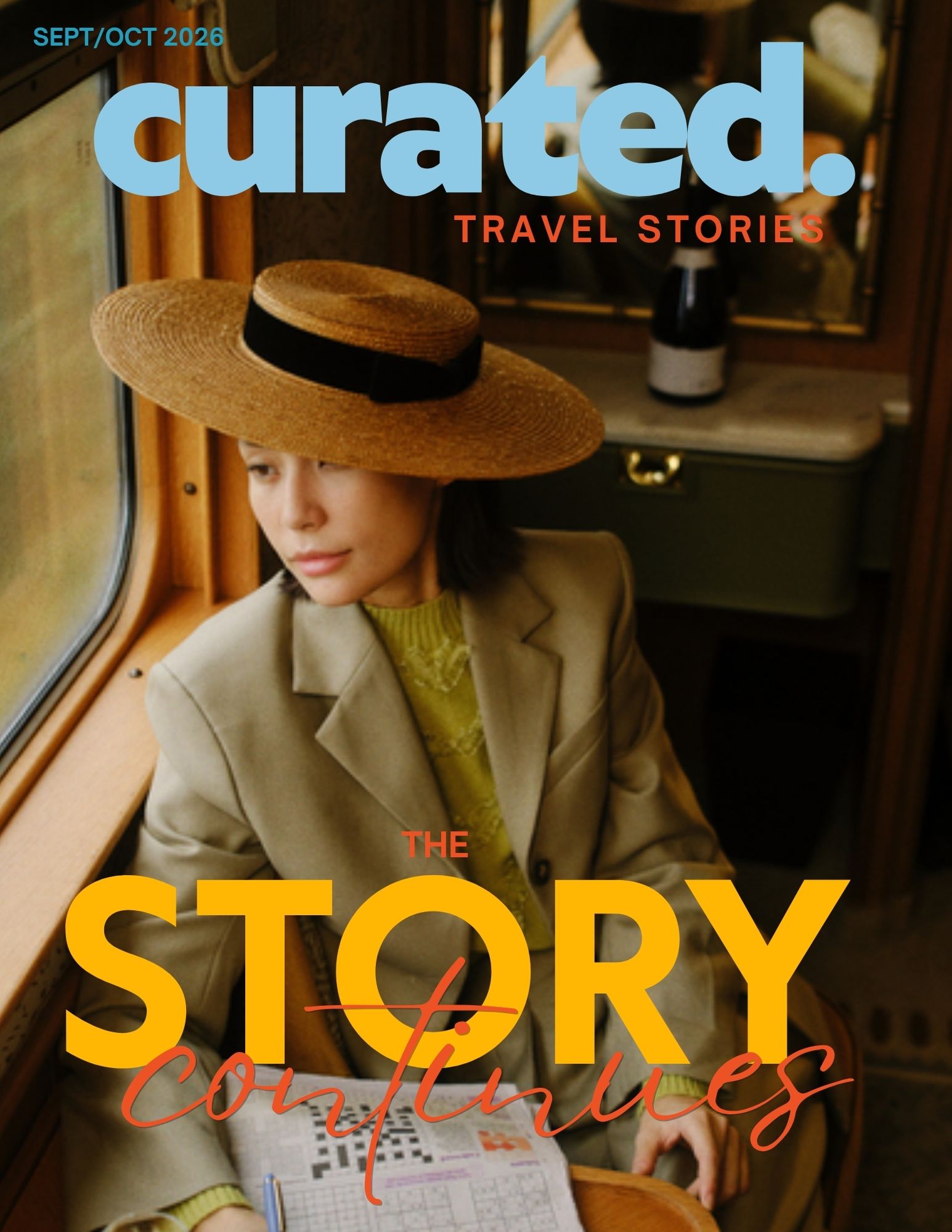
This piece is part of the latest issue of Curated Travel Magazine, where we explore travel through immersive stories, cultural insight, and thoughtfully curated experiences around the world.
Enjoyed this article? Read more or subscribe:
Read online: Explore the full issue and archive at curatedtravelmagazine.com/issues.html.
Digital Subscription: Subscribe or purchase digital editions on Zinio.
Print Edition: Prefer a physical copy? Order print editions directly via Lulu.